// digital id: decoded
A quick note before we start. A few people close to me, family, friends, some from different corners of my life, have reached out lately asking about all this. Digital id, age verification, what’s actually happening, some fully unaware, some knowing snippets from a headline. So this one’s written differently to most of what’s on TAZ. Less essay, more me walking you through something I’ve spent a lot of time untangling, for anyone who’s been asking. Still thorough, still honest about what’s uncertain, just less philosophical scaffolding. If that’s not your thing today, the usual TAZ voice will be back next time.
in this piece
- part one | the architecture
- part two | beyond id, and what happens when the system says no
- part three | building resilience without leaving
- part four | a different kind of resilience
- bonus | if the ideal isn’t available to you yet
part one | the architecture#
Okay, let’s start with the actual mechanics, because most explanations of digital id either stay way too high level, “it’s an app for your id,” or jump straight into fear without showing the plumbing. I want you to actually understand how this thing is built, so you can see for yourself where the risk lives, rather than take my word for it.
the trust triangle#
Every digital id system, the EU wallet, the UK’s version, whatever the Five Eyes end up standardising on, runs on the same basic shape. Three players.
The issuer. That’s a government body, the one that already knows who you are because they issued your passport or your driver’s licence. They’re the ones putting credentials into your digital wallet in the first place.
The wallet. That’s the app on your phone. It holds your credentials and presents them when asked.
The relying party. That’s whoever’s asking you to prove something. A bank doing KYC. A website doing age verification. A bar checking you’re over eighteen.
The idea, on paper, is that these three don’t need to talk to each other constantly. The wallet proves a claim, the relying party accepts it, and that’s meant to be the end of the transaction.
selective disclosure, and what it actually protects#
Here’s the part that sounds genuinely good, and to be fair, I think the cryptography behind it is good. Instead of showing someone your full id, the wallet can prove a single fact. “This person is over eighteen.” Nothing else. Not your name, not your address, not your date of birth.
That’s done through a mechanism called selective disclosure, sometimes built on something called zero knowledge proofs, though most real-world implementations right now use a simpler version called selective disclosure JWTs. I won’t go deep into the cryptographic weeds here, but functionally, think of it as a sealed envelope where you can only see the one fact you were shown, not the rest of the letter.
This genuinely does limit what a nightclub bouncer or a website learns about you compared to handing over your full licence. I want to be fair about that. The problem isn’t this layer. It’s everything underneath it.
where google and apple’s visibility ends#
A question worth asking early, because people assume the answer is scarier than it is. Does Apple or Google see your id data, since the wallet lives on their phones?
Mostly, no. The wallet app itself is usually built or approved by the government, not Apple or Google. What Apple and Google do provide is the secure hardware underneath it, the secure enclave on iPhone, the trusted execution environment on Android, where the cryptographic keys actually live. So the phone maker can tell a wallet exists and is using secure storage. They can’t see what’s inside it.
That’s a genuine privacy boundary. I’m not going to pretend otherwise. The government issuer knows what they issued you. You hold the proof. The relying party sees only the one attribute you disclose.
So where’s the catch, if all of that sounds reasonable?
the phone was never the real record#
Your phone is a copy. It’s not the source of truth. The actual master record sits in a national identity register, the same database that already backs your passport.
Which raises an obvious practical question, what happens if you lose your phone? You re-authenticate with the issuer, probably biometrically, and they push a fresh credential to a new device.
And there’s a second piece most explanations skip entirely. A status list, sometimes called a revocation registry. This is a live, centralised service that the relying party quietly checks every single time you present a credential. Is this still valid. Has it been revoked. Has it been flagged.
So even though the content you disclose is minimal, one attribute, no name, the act of checking pings a central government server. Every single time. That’s a metadata trail, and it’s the part that barely gets discussed in the public pitch for these systems.
the quiet centralisation nobody’s really talking about#
Here’s something I think is genuinely underappreciated. Most countries’ identity data right now is a mess, in a good way, from a privacy perspective. Your tax record, your health record, your driver’s licence, your births register, these often don’t talk to each other cleanly. They’re siloed, sometimes by design, sometimes by decades of bureaucratic drift.
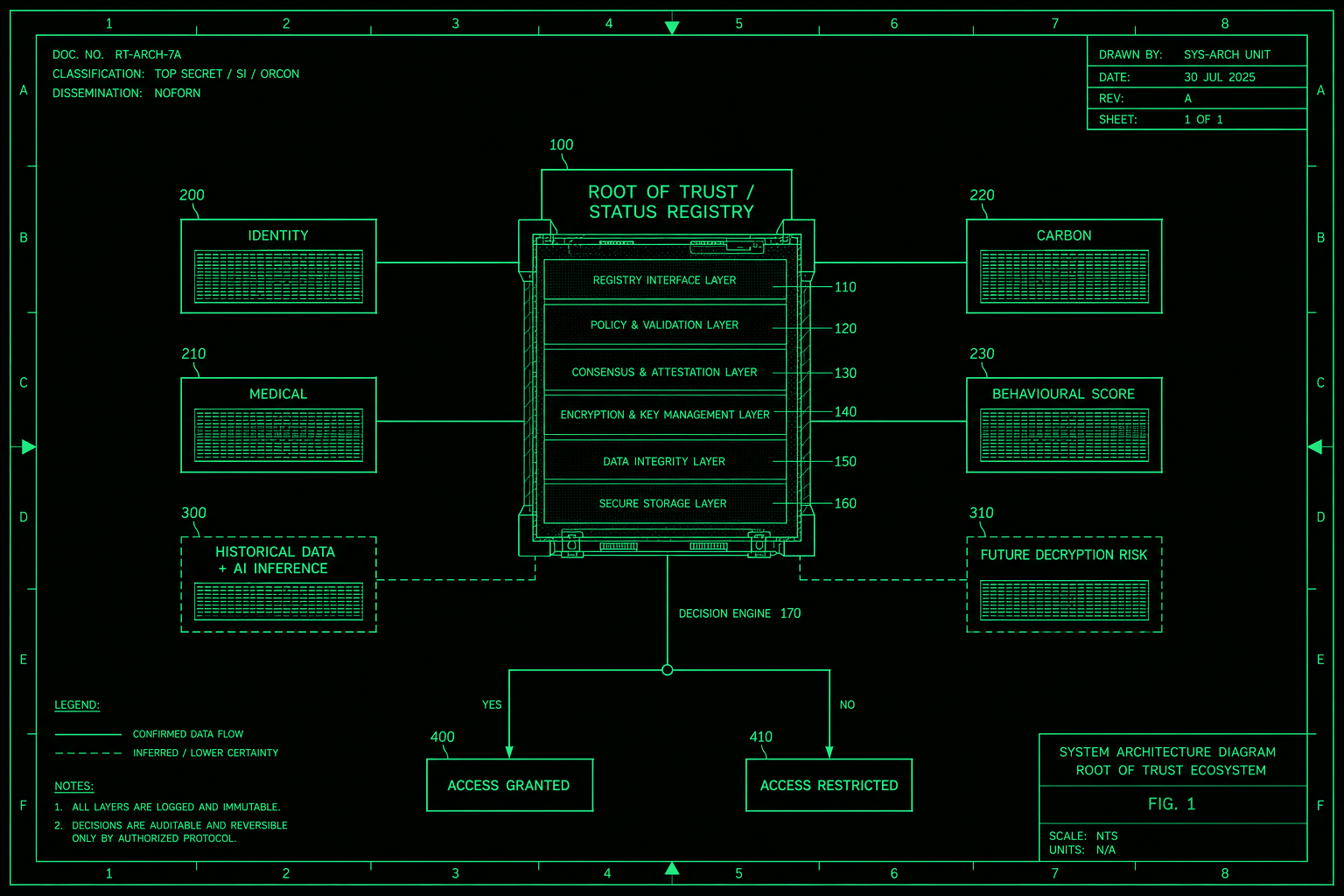
Digital id mandates a level of interoperability that hasn’t existed before. Not necessarily one shiny new mega-database, but a federation standard, a unified layer, that lets these previously separate systems be queried consistently and in real time.
That’s the quiet cost of the rollout that doesn’t make it into the marketing. It’s not “we built a new database to track you.” It’s “we made all your old, disconnected data suddenly queryable together.” Which, functionally, gets you to roughly the same place.
The architecture below maps this out:
status isn’t binary, and that matters more than people think#
One more piece before we move to part two. That status list I mentioned isn’t just valid or revoked. It can carry conditions. Restricted. Under review. Flagged pending verification.
Which means a credential doesn’t need to be cancelled to stop working for you. It just needs to be paused. And because so many services are increasingly drawing from that same root of trust, banking, healthcare portals, transport, a pause in one place can ripple out everywhere at once.
We’ll get into exactly how that plays out in part two, because this is where the theoretical architecture turns into something with real, immediate consequences.
a genuine caveat before we go further#
I want to be upfront about something. Some of what I’ve described, particularly the conditional status flags and how uniformly they’re implemented, is closer to architectural capability than confirmed, universal current practice in every jurisdiction right now. The EU wallet is still being rolled out in stages. Not every piece I’ve described is live everywhere today. I think it’s important I say that plainly, rather than let the mechanics and the current reality blur together.
What I can say confidently is that the architecture makes this possible, and in some places, pieces of it are already operational. How far it’s been pushed varies by country, and that’s worth you checking for wherever you are, rather than assuming uniformity.
part two | beyond id, and what happens when the system says no#
it’s never just id#
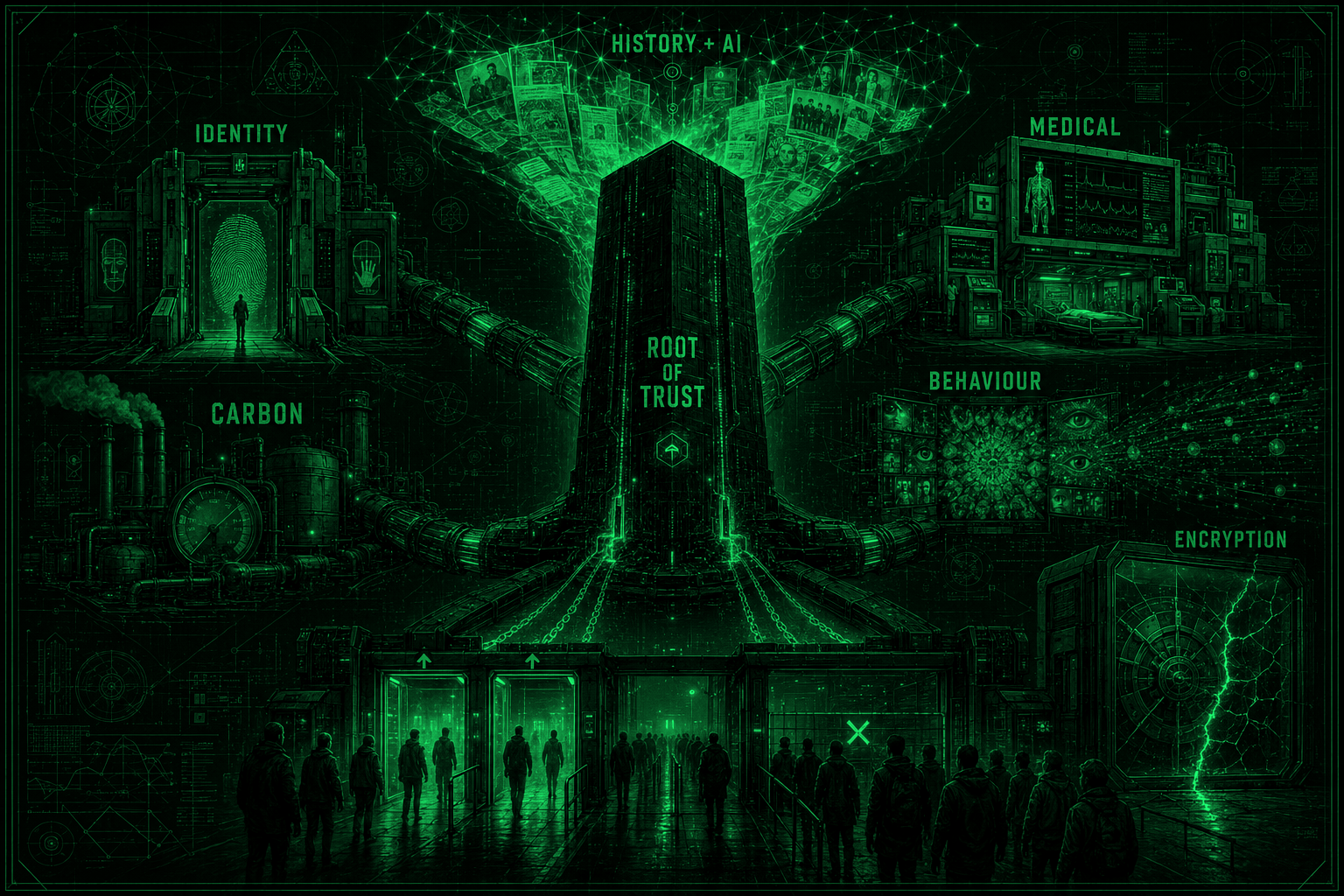
Here’s the thing that took me a while to properly connect. Digital id on its own, even with all the centralisation risk we covered in part one, is really just the foundation. The actual concern is what gets built on top of it once it’s normalised as the default authentication layer for everything.
And this isn’t hypothetical hand-waving. Some of it is already happening. Some of it is proposed and piloted. And some of it is genuinely speculative, further down the road if things keep trending the way they’re trending. I want to be clear about which is which as we go, because I think that distinction actually makes the argument stronger, not weaker.
the medical layer, already fused#
This one’s not speculative at all. We already ran the trial. Vaccine passports were, functionally, a medical status flag bolted onto an identity check, and for a while, access to basic services depended on it. That genie doesn’t go back in the bottle just because the acute justification faded. The architecture that got built to support it, health status tied to access, is still there, still callable, for whatever the next declared emergency turns out to be.
the carbon layer, actively proposed#
Less known, but real. Parts of Europe have floated, and in some cases piloted, personal carbon allowance schemes, where individual consumption, flights, fuel, even certain purchases, gets tracked against a personal carbon budget. It’s not universal policy yet, but it’s not fringe speculation either, it’s sitting in real policy papers and pilot programs. Once identity is the authentication layer for financial transactions, tying a carbon ledger to that same identity is a small technical step, not a large one.
behavioural and financial risk scoring, quietly already normal#
We already live with informal versions of this. Credit scores. Insurance risk models. Fraud detection systems at your bank. These already ingest behavioural data and produce a score that gates access, to loans, to premiums, to accounts. It’s not badged as “social credit,” and it’s fragmented across different institutions rather than unified, but the underlying logic, behaviour in, access decision out, is already live infrastructure. The only real question is how far and how unified that scoring gets once everything routes through one identity layer instead of many separate ones.
historical data and ai, the part that never expires#
This is worth sitting with. Once data is collected, it tends not to disappear. Retention policies vary, but the trend is long windows, not short ones. And AI doesn’t need real-time surveillance to be dangerous, it can retroactively mine years of historical transaction, location and behavioural data and find patterns nobody was looking for at the time. So even data collected years ago, under a different political climate, with different stated intentions, becomes fresh material the moment someone points a new model at it.
decryption, the speculative but documented piece#
Here’s the one I want to be most careful with, because it’s real, but it’s not certain. There’s a documented strategy called “harvest now, decrypt later.” The idea is that adversaries and governments are already storing encrypted traffic today, betting that quantum computing will eventually be capable of breaking that encryption open retroactively. This isn’t conspiracy theory, it’s an acknowledged strategic concern in cryptography and intelligence circles right now.
What’s genuinely uncertain is the timeline, and whether it happens at meaningful scale. Quantum computing capable of breaking current encryption standards isn’t here yet, and estimates on when it might arrive vary widely. So this is the one piece of the picture I’d flag clearly as speculative in its consequences, even though the strategy behind it is real and already being executed.
putting it together#
So, stack it up. An identity layer that unifies previously siloed data. A medical status flag we’ve already seen deployed. A carbon layer being actively piloted. Financial and behavioural scoring already running quietly in the background. Historical data that doesn’t expire. AI that can mine all of it retroactively. And, longer term, a real possibility that even what’s encrypted today doesn’t stay private forever.
No single piece of that is unprecedented on its own. What would be unprecedented is all of it running through one root of trust, at the same time, for the same person. That’s the part worth taking seriously, not because it’s guaranteed, but because the individual pieces are demonstrably real, and the incentive to connect them is already there.
now, what happens when the system says no#
This is where it stops being abstract. Once your identity, your finances, and your movement all check against the same source of truth, denial doesn’t need force. It just needs a status flag.
mosaic theory, or why one data point isn’t the danger#
There’s a concept from privacy and intelligence literature called mosaic theory. The idea is simple, no single piece of data about you is usually dangerous on its own. Your age verified at a bar. Your location pinged at a train station. Your purchase at a pharmacy. Individually, boring. But strung together across time, they form a mosaic, a behavioural picture that’s far more revealing than any single tile.
Digital id is specifically the connective tissue that makes that mosaic buildable at scale, because every check-in against that status list we talked about in part one is timestamped and often location-tagged. It’s not that any one government official is watching you personally. It’s that the aggregate becomes queryable, and query is a form of power.
from passive logging to active inference#
Here’s the shift that matters most, and it’s subtle enough that most people miss it. Logging your activity is passive, it just sits there. Inference is active, it’s a system making a probabilistic judgment about you based on pattern, not evidence of anything you’ve actually done.
Once that shift happens, you don’t need to do anything wrong to get flagged. You just need to match a pattern the model has learned to treat as risky. That’s a genuinely different kind of exposure than “the government has a file on me.” It’s “the government has a model that scores me, and I don’t know what it’s scoring on.”
and here’s the part that should worry people more than surveillance itself#
Once digital id becomes the default authentication layer, and it’s already heading that way for banking under know-your-customer rules, non-participation itself starts to look suspicious. Using cash instead of the app. Declining a permission. That friction, which used to just be a personal choice, becomes an anomaly in a system built around universal participation.
what denial actually looks like#
So let’s make this concrete, because I think it’s genuinely under-imagined by people pushing this stuff through, mostly under a “protect the children” or “stop the criminals” banner, without engaging with the architecture they’re actually building.
Remember that status list isn’t binary. It’s not just valid or revoked. It can carry conditions, restricted, under review, flagged pending verification. Your credential doesn’t need to be cancelled to stop working. It just needs to be paused.
Picture it. Your credential gets marked for review, no revocation, just a pause. Your bank transaction fails at the checkout. Not because your bank blocked you specifically, but because the identity layer underneath your bank couldn’t confirm clean status in that moment. You can’t buy groceries. If transport is tied to the same id, you can’t board a train. Healthcare portals stop responding. All at once, because it’s all drawing from the same root of trust.
And this is the actual nightmare scenario, worse than any single company or agency deciding to target you. It’s infrastructure-level dependency. Once every service checks the same source of truth, that source becomes a single point of failure that can be leaned on selectively and quietly, no public order, no court ruling required. Just a status change in a database somewhere.
this isn’t hypothetical, we’ve already seen small versions of it#
Two real examples, useful because they show the mechanism actually works, not just in theory.
Canada, early 2022. The trucker convoy protests. The federal government invoked the Emergencies Act and directed banks to freeze the accounts of protest organisers, and even some people who’d simply donated. No court order first. No charges. Just an administrative directive, and bank accounts, personal and business, frozen instantly. It was reversible once the emergency order lifted, but it proved the mechanism works in a Western democracy with due process norms on paper. Financial access can be switched off as a political tool, using rails that already existed. No new law needed, just an emergency invocation.
China’s social credit system is the more chronic version. It’s not one unified score the way it’s often imagined in Western media, it’s fragmented across local pilots and specific systems. But the travel restriction piece is well documented. Courts can flag someone as a “discredited debtor,” and that flag propagates into ticketing systems. The person literally cannot buy a high-speed rail or plane ticket, the system just declines the transaction at checkout. No confrontation. Just friction, until compliance.
the throughline#
Both examples point at the same underlying truth. Once identity, finance, and movement share infrastructure, restriction doesn’t need force. It just needs a flag.
So that’s the architecture, and that’s what happens when it says no. All of it, useful on paper, quietly totalising in aggregate. Which raises the only question that actually matters once you’ve understood the mechanics.
What do you actually do about it?
part three | building resilience without leaving#
Alright, so given everything we’ve mapped out, the architecture, the scope creep beyond just id, what denial actually looks like, the obvious next question is what you actually do about it. This part is the practical one.
I want to be upfront about the frame here. Everything in this section is mitigation within the system. It reduces your exposure and gives you fallback rails if one gets cut off. It doesn’t get you outside the system entirely, that’s part four’s territory. But it’s the part most people can actually start doing today, regardless of where they live or what resources they’ve got.
why redundancy is the actual principle#
Before the specifics, the underlying logic matters more than any single tool. The goal isn’t finding one perfect alternative to replace the mainstream system. It’s having multiple rails that don’t share the same point of failure, so if one gets restricted, you’re not stranded.
cash, still the baseline#
Obvious, but worth saying plainly. Cash is still legal tender almost everywhere, and it’s still untraceable at point of sale. The problem is usability is shrinking, more places are going cashless by default, sometimes by policy, sometimes just by convenience creep. Keeping cash as a habit, not just an emergency stash, matters, because a rail you haven’t practiced using is a rail you’ll fumble when you actually need it.
crypto, and why it’s not one thing#
Bitcoin and Monero get lumped together a lot, but they behave very differently here. Bitcoin is pseudonymous, not anonymous, if it ever gets linked to your identity, the entire transaction history tied to that wallet becomes visible. Monero is actually private at the protocol level by default, which matters if the goal is a rail that can’t be correlated back to you even under real pressure.
That said, and this is worth being honest about, crypto alone is still a single point of failure if regulation tightens hard enough on-ramps and off-ramps. It’s one tool in the kit, not the whole kit.
precious metals, the oldest hedge there is#
Gold and silver have no counterparty and no digital trail. Historically, they’ve held value across collapse scenarios where digital rails failed entirely, currency crises, banking freezes, war. The tradeoff is liquidity, you can’t tap a bar of silver to pay for groceries. It’s a store of value, not a transaction rail. Different job, still worth holding.
local currencies and mutual credit#
Less well known, genuinely useful. These are community-level networks where people trade goods and services using an informal or semi-formal ledger that never touches the banking system at all. Historically, these flourish exactly when access to official currency gets restricted, which tells you something about their actual purpose.
foreign banking diversification#
Holding accounts or assets in a jurisdiction with different legal triggers than where you live means a domestic emergency order, like what happened in Canada in 2022, doesn’t touch everything you have at once. This isn’t about hiding money, it’s about not having your entire financial life sit under one legal authority’s ability to freeze it overnight.
barter networks#
Unglamorous, but resilient. Direct trade of skills or goods with people you actually trust. No settlement layer at all, nothing to freeze, nothing to flag. It’s slow and it doesn’t scale to your whole life, but it’s real, and it’s been the fallback layer for humans a lot longer than banking has.
identity minimization#
This is the second half of resilience, alongside the financial piece. The core idea, reduce how many systems require your primary, government-linked identity to function day to day.
Practically, that means using pseudonymous identities and separate email aliases for anything that doesn’t legally require your real name, which is a lot more than most people assume once you actually check. It means defaulting to cash or privacy-respecting payment methods for routine, low-stakes purchases, so your primary identity isn’t the thing quietly stitching together your grocery runs, your coffee habit, and your daily movements into one file.
It also means being deliberate about which services genuinely need biometric or hard KYC verification, versus which ones you’ve just defaulted into handing it over because it was the path of least resistance. And physically, it means using devices and operating systems that don’t phone home constantly, so your digital exhaust isn’t quietly accumulating under one identity graph even when you’re not actively interacting with a government system.
an honest caveat#
None of this makes you invisible, and I don’t want to oversell it as if it does. Most of these steps add friction and redundancy, they don’t remove you from the system. Someone determined enough, with enough resources, can still trace most of this if they really want to. What this actually buys you is resilience against the common case, a status flag, a frozen account, a denied transaction, rather than protection against a maximally resourced, individually targeted effort. That distinction matters, and I’d rather be straight about it than let the piece imply more safety than it delivers.
the limits of mitigation#
And here’s the honest edge of this whole part. All of this, cash, crypto, metals, aliasing, redundancy, it reduces your exposure inside a system that’s still fundamentally centralizing around you. It doesn’t change the architecture. It just gives you more room to move within it.
Which brings us to the actual different-in-kind option, the one that doesn’t just add redundancy, it reduces dependency on the system itself.
part four | a different kind of resilience#
Everything in part three was mitigation. Useful, real, worth doing. But it’s still playing within the system’s rules, just with more redundancy built in. This part is about something different in kind, not reducing your visibility to the system, reducing your dependency on it in the first place.
why this is a different category, not just a bigger version of part three#
Cash, crypto, aliasing, all of that assumes you’re still plugged into the mainstream economy and just want fallback rails. Rural, self-sufficient, like-minded community is a different move entirely. It’s asking, what if fewer parts of my daily survival routed through the centralized system at all, not just what happens when it says no.
why rural, specifically#
Big cities are where this infrastructure is most complete and most enforced first. Dense populations make surveillance and control infrastructure more cost-effective to deploy and harder to opt out of, cashless payment defaults, ubiquitous cameras, transit systems tied to id, everything we’ve mapped out across this piece tends to land hardest and earliest where the population density makes it easiest to roll out.
Rural, lower-density living isn’t just aesthetic preference or nostalgia. It’s structurally further from where this gets deployed first and most completely. That buys time, and in some cases, it buys genuine distance.
self-sufficiency as the actual core of it#
The piece here isn’t really about geography on its own. It’s about food, water, energy, and community ties that don’t depend on the systems we’ve spent this whole piece mapping. Growing or sourcing your own food locally. Water that doesn’t run through a smart metering system tied to your identity. Energy that isn’t solely grid-dependent. Relationships and mutual support that exist face to face, not mediated through a platform that can revoke your access.
The less of your actual survival runs through centralized rails, the less any single status flag can touch.
like-minded community, the part that’s easy to underestimate#
This is the piece that’s hardest to build alone, and honestly the most important one. A person doing all of this solo is resilient in theory but isolated in practice. A small community doing it together, sharing skills, sharing food production, sharing trust, is resilient in a way that actually holds up under pressure. It’s not just about resources, it’s about having people who share your read on what’s happening and won’t think you’re paranoid for taking it seriously.
a pattern worth naming#
Once you’re looking for it, there’s a pattern in how this space has been treated over the last few years. Homesteading and off-grid living get quietly coded as fringe or suspicious in mainstream coverage. Food sovereignty and small-scale local agriculture face real regulatory pressure in places, sometimes for genuine safety reasons, sometimes in ways that conveniently squeeze out small operations in favor of larger, more centrally trackable ones. Community currencies and local barter networks tend to lose legal ground exactly as centralized digital payment rails expand.
I don’t think this is one coordinated conspiracy. I think it’s the same structural logic showing up independently in a lot of places, centralized dependency is fragile to central control, and distributed self-sufficiency isn’t, which means distributed self-sufficiency is inconvenient to systems that are optimizing for control, whether or not anyone involved is thinking about it in those terms.
an honest caveat, because this section deserves one too#
This path isn’t available to everyone, and I don’t want to write this as if it is. It requires capital, land access, physical ability, and often the flexibility to leave an existing job, mortgage, or family situation, none of which are equally distributed. It also has real tradeoffs, less access to specialized healthcare, less convenience, more physical labor, more exposure to different risks, weather, isolation, self-reliance failures. It’s not a strictly better life for everyone, it’s a different set of risks traded for a different set of freedoms. I think it’s honest to say plainly, this section may describe an option some readers simply can’t access right now, and that’s worth sitting with rather than glossing over.
bonus | if the ideal isn’t available to you yet#
Most people reading this aren’t in a position to pack up and build a homestead next month. That’s normal, and it doesn’t mean the whole conversation is irrelevant to you. It means the useful question shifts from “how do I get there” to “how do I build toward it from wherever I actually am.”
start with knowledge, not land#
Skills transfer regardless of where you live. Learning to grow food, even in pots on an apartment balcony, learning basic food preservation, learning practical off-grid skills like water filtration or basic energy independence, none of that requires owning rural land. It requires starting, and it compounds. Someone who’s spent two years learning these things has a real head start over someone who waits until they have the perfect property to begin.
trial and error while you’re still in the system#
This applies to part three’s tools too. You don’t need to be in crisis to open a Monero wallet and actually learn to use it. You don’t need to be denied a transaction to test what life looks like paying cash for a week. Practicing these things while the stakes are low means you’re not learning under pressure the first time it actually matters.
find your people before you need them#
Community doesn’t have to mean physically relocating yet. It can start as a handful of like-minded people you trust, in your current city, who share your read on where things are heading. Those relationships are the seed of the community piece, even before geography changes. Shared skills, shared information, mutual trust, that infrastructure can start building now, wherever you are.
incremental resilience is still resilience#
The goal isn’t an all-or-nothing leap to full self-sufficiency. It’s a direction, not a destination. Every skill learned, every rail practiced, every relationship built with someone who shares your read on this, moves you closer, even if the full picture, the land, the community, the food independence, is years away. That’s not a consolation prize. That’s just what building resilience actually looks like for most people, gradual, deliberate, and starting from exactly where you are.